




Introduction
Why is the sky blue? How do plants grow? What makes a toy car move faster on a ramp? If you’ve ever heard your child ask endless “why” questions, you’ve seen science in action. Children are natural scientists—constantly observing, experimenting, and seeking to understand the world around them.
At Global Einstein Institute (GEI), we believe curiosity is the foundation of lifelong learning. Science and discovery are not just subjects we teach—they are ways of thinking we encourage every day. By creating spaces where children explore, question, and investigate, we turn their natural wonder into meaningful learning.
Understanding Science & Discovery in Child Development
Science is not limited to facts in a textbook. For children, it is:
- Observation: Noticing changes in the environment.
- Experimentation: Trying, testing, and exploring cause-and-effect.
- Inquiry: Asking questions and searching for answers.
- Problem-Solving: Finding solutions through trial and error.
Developing these skills early helps children grow into critical thinkers who are confident in exploring both successes and mistakes.
How Science Shows Up in Daily Learning
Science is everywhere in a child’s daily life, even if it doesn’t look like “science class.” For example:
- At home: Mixing water and soap to blow bubbles introduces chemistry and air pressure.
- On the playground: Sliding down a slide demonstrates gravity and motion.
- In the classroom: Planting seeds and observing growth fosters understanding of biology and patience.
Everyday experiences become powerful lessons when children are encouraged to notice, ask, and wonder.
GEI’s Approach to Science & Discovery
At GEI, we nurture scientific curiosity by combining structured experiments with open-ended exploration. Our approach includes:
- Hands-On Experiments
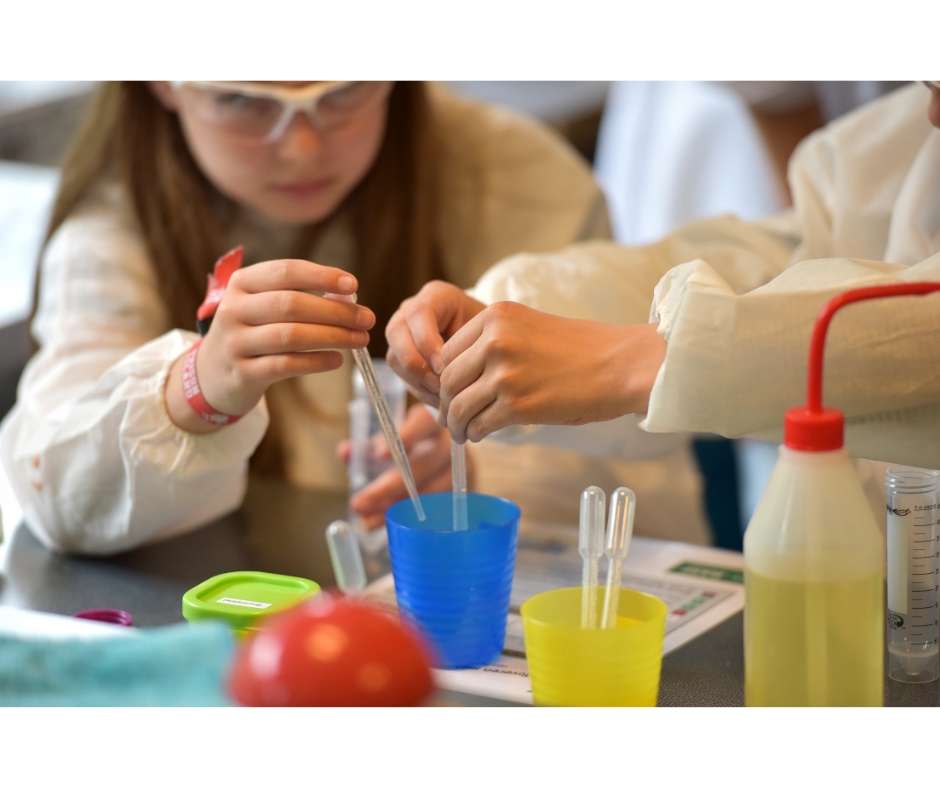
- Children engage in age-appropriate experiments: mixing colors, making volcano models, or testing buoyancy with objects in water.
- These activities turn abstract ideas into concrete experiences.
- Inquiry-Based Learning
- Teachers encourage children to ask questions and make predictions.
- Instead of giving ready answers, we guide them to explore and discover solutions themselves.
- Real-World Connections
- Field trips, nature walks, and classroom projects link science to daily life.
- Children learn that discovery is not confined to a lab—it is everywhere.
- Integration Across Domains
- Science links with Mathematics (measuring and data collection), Language & Communication (explaining findings), and Cognitive Development (analyzing results).
- By embedding discovery across all 10 GEI domains, children see science as part of everything they do.
Conclusion
Science is not just about facts—it’s about curiosity, exploration, and discovery. At GEI, we believe every child is a scientist at heart, capable of asking meaningful questions and finding creative answers. By nurturing this natural curiosity, we prepare children not just for school, but for a lifetime of learning and discovery.
At Global Einstein Institute, we turn “why” into wonder. Join us in fostering your child’s journey as a confident, curious explorer.